We are based on the local area and look at the worldHomepage - English
Hon Hai Group
Homepage
America
Mexico
Europe
Czech Republic
Slovakia
Press Center
Latest News
Foxconn, Radiall and Thales inaugurate Tessalia to produce more than 50 million “made in Europe” components annually
2026/06/01
Foxconn, Radiall and Thales inaugurate Tessalia to produce more than 50 million “made in Europe” components annually
*On Monday, June 1, 2026, Foxconn, Radiall and Thales laid the foundation stone for their future joint venture at Le Barp (Nouvelle-Aquitaine) as part of the Choose France 2026 Summit, in the presence of the French Minister Delegate to the Minister of the Economy, Finance, and Industrial, Energy and Digital Sovereignty, responsible for Industry, Mr. Sébastien Martin, the President of S Business Group for Hon Hai Technology Group (Foxconn), Dr. Bob Wei-Ming Chen, the Chairman and CEO of Radiall, Mr. Pierre Gattaz, the Chairman and CEO of Thales, Mr. Patrice Caine and the President of the Nouvelle-Aquitaine Region, Mr. Alain Rousset. *This company, called Tessalia Technology SAS, will be dedicated to Outsourced Semiconductor Assembly and Testing (OSAT). It aims to produce more than 50 million System in Package (SiP) components per year by 2033. *Within the framework of the EU chips act, this project represents a major step forward in strengthening the French and European semiconductor ecosystem, increasing its capacity for innovation, strategic autonomy and competitiveness.   One year after the announcement by the President of the French Republic, Mr. Emmanuel Macron, at the Choose France 2025 Summit, of the initiation of preliminary discussions among Hon Hai Technology Group (Foxconn), Radiall and Thales, the three companies laid the foundation stone of their future joint venture at Le Barp, near Bordeaux (Nouvelle-Aquitaine), on Monday, June 1, 2026. Le Barp is located in the heart of a rich academic and industrial ecosystem, close to the “Route des Lasers” and with the presence of numerous cleanrooms and a large pool of expertise in these fields.   Foxconn, the world’s largest electronics manufacturing service provider, Radiall, a leading French manufacturer of high-performance interconnect solutionsfor demanding industries, and Thales, a global leader in advanced technologies, have named this new company Tessalia, referring to the tiles of a mosaic (from the Latin “tessella”). They are combining their strengths to create, test and assemble advanced packaging solutions for electronic chips (Systems in Package, SiP) for aerospace, telecom infrastructure, automotive and medical sectors notably. Tessalia will use an innovative encapsulation technology aimed at developing ultra-high-density packaging. This will help simplify printed circuit boards (PCBs) and create smaller, lighter components, thereby improving their integration capability. This technology is emerging as a breakthrough in terms of yields and competitiveness for future products.   Tessalia aims to: -        Be a sovereign and competitive company to meet European needs in the field of semiconductor packaging in strategic sectors. Tessalia will have access to the technology from Foxconn under agreed licensing arrangements. -        Provide to its customers a single interface to manage the entire implementation of advanced packaging for electronic chips. This vertical approach simplifies the packaging stage and guarantees reduced cycle time. It also minimises the carbon footprint of the sector by reducing round trips with multiple suppliers distributed worldwide; -        Promote an autonomous and open player able to manage the European packaging market ecosystem.   Production is expected to start at the end of 2029 and to reach more than 50 million System in Package (SiP) components per year by 2033. This initiative aims to welcome other industrial players to support an investment that could exceed €250 million by 2033. Tessalia is expected to have 800 employees at full production.   In a context of surging demand for electronic equipment and artificial intelligence, and of geopolitical tensions disrupting global supply chains, semiconductor production has become a major strategic challenge, leading to a readjustment of the sector, an acceleration of production capacities and the development of new technologies.   “This new advanced capacity is a key sovereign asset for the European and French semiconductor industry. This project aligns perfectly with Radiall’s strategy, enabling the development of our next advanced connection solutions for demanding applications.” Pierre Gattaz, Chairman and CEO, Radiall   “This is not just a factory. It is a strategic platform for advanced manufacturing, semiconductor resilience, and future technologies in Europe. This project also supports Foxconn’s strategy of Build-Operate-Localize, which expands our global technology footprint through trusted partnerships.” Young Liu, Chairman, Foxconn   “The laying of this first stone today demonstrates our shared ambition, together with Radiall and Foxconn, to build an innovative and competitive European player in the advanced semiconductor packaging market, in a context of strong competition. Tessalia is part of a drive for independence and control over the value chain of all our electronic products.” Patrice Caine, Chairman and CEO, Thales   “I am delighted to welcome this strategic factory, which is crucial for our sovereignty in the electronics sector. It strengthens our regional ecosystem in this sector, which already represents 20,000 jobs. This project also rewards our long-standing efforts in reindustrialization, which have enabled us to become the leading region in France in terms of creating factories”. Alain Rousset, Président, Nouvelle-Aquitaine Region   About Foxconn Hon Hai Technology Group (Foxconn) (TWSE:2317) is the world’s largest electronics manufacturer and leading technology solutions provider, ranking 28th in Fortune Global 500. In 2025, revenue totaled TWD8.1 trillion (approx. USD260 billion). The Group’s market share in electronics manufacturing services (EMS) exceeds 40% and covers four major product segments: smart consumer electronics; cloud and networking; computing; and components and other. Operating over 240 campuses across 24 countries, Foxconn is one of the world’s largest employers with approx. 900,000 employees during peak manufacturing season. We are committed to sustainability in the manufacturing process and serving as a best-practice model for global enterprises. The Group is guided by its 3+3+3 strategy, actively investing in industries of electric vehicles, digital health, and robotics; in technologies of artificial intelligence, semiconductors and next-generation communications; in intelligent platforms of Smart Manufacturing, Smart EV and Smart City. Foxconn is dedicated to becoming a comprehensive, world-class enterprise, with AI as its core driving force. Learn more at www.foxconn.com/en-us   About Radiall Founded in 1952, Radiall is a global manufacturer of advanced interconnect solutions, employing over 3,500 people worldwide. The company offers a comprehensive range of RF connectors and cables, coaxial switches, fiber optic and microwave components, multi-contact connectors and more, supported by an international presence ensuring close customer support.   About Thales Thales (Euronext Paris: HO) is a global leader in advanced technologies. Its portfolio of innovative products and services helps address several major challenges: sovereignty, security, sustainability and inclusion. The Group allocates €4.5 billion per year in Research & Development in key areas, particularly for critical environments, such as Artificial Intelligence, Cybersecurity, Quantum and Cloud technologies. Thales has more than 85,000 employees in 65 countries. In 2025, the Group generated sales of €22.1 billion.
2026/06/01
Bull and Foxconn partner to scale Europe’s manufacturing capabilities for artificial intelligence infrastructures
2026/06/01
Bull and Foxconn partner to scale Europe’s manufacturing capabilities for artificial intelligence infrastructures
Paris, France – 1 June, 2026 –Bull, a leader in advanced computing and AI, and Hon Hai Technology Group (Foxconn), the world’s largest electronics manufacturer and leading technology solutions provider, announce a strategic collaboration to manufacture AI and Cloud infrastructure, from Europe to the global market. The partnership will combine Bull’s leadership in AI systems design, deployment and go-to-market, with Foxconn’s global manufacturing scale and supply chain capabilities,to enable the delivery of AI infrastructure solutions, including computing systems and related componentsleveraging Bull’s factory in Angers (France) and Foxconn’s factories in Pardubice (Czech Republic). Strengthening a resilient European supply chain for neo-cloud providers and AI factories This approach will address the growing needs of European AI Factories initiatives and neo-cloud providers to reinforce regional industrial capacity, while maintaining competitiveness in terms of cost, quality and time-to-market. The partnership focuses on European AI Factory and Infrastructure, closely aligning with the strategic vision for Sovereign AI. By anchoring the localized AI supply chain and computing capabilities in France, the initiative aims to serve as a key enabler for Europe’s sovereign AI ecosystem. To execute this strategic deployment in France, the project is expected to involve an initial investment exceeding EUR 120 million. At a time when artificial intelligence is becoming a critical economic infrastructure, industry analyses show that Europe remains significantly dependent on external markets for key components and technologies, exposing it to potential supply disruptions and limiting its industrial autonomy. Today, Europe accounts for around 8% of global semiconductor manufacturing capacity, according to ING, and holds less than 5% market share in several key AI infrastructure segments, including cloud and advanced computing platforms, as highlighted by McKinsey. Delivering next-generation AI servers and systems from France and the Czech Republic Bull and Foxconn will initially focus on the manufacturing enablement and industrialization of AI system, designed for demanding workloads such as AI training and inference. These systems will integrate advanced processors, including GPUs and other accelerators, together with high-performance memory, storage, scale out and scale up interconnect technologies. Designed as standalone systems or rack-level configurations, they will address the needs of a wide range of users – including enterprises, cloud and neo cloud service providers, research institutions and emerging AI factories, contributing to the expansion of a more structured and scalable AI ecosystem made within the European borders. From an industrial perspective, manufacturing and initial testing will be carried out in Foxconn’s facilities in the Czech Republic, before assembly, final integration and system-level validation at Bull’s factory in Angers (France). For Emmanuel Le Roux, CEO of Bull “This partnership with Foxconn accelerates our transformation by positioning Bull as a key European player in AI and cloud systems, leveraging Bull’s technical leadership in HPC, with the ability to deliver the most advanced infrastructure at scale and with competitive time to market. It marks an important step in the execution of our strategy to address neo-cloud providers and AI Factories across Europe, India, Latin America. By joining forces with Foxconn, we are taking a concrete step to deliver competitive AI infrastructure made in Europe while contributing to a more resilient digital ecosystem within Europe.” For Jesse Chao, Head of AI & Quantum at Foxconn: ”Leveraging our global manufacturing expertise and growing European footprint, we aim to provide scalable and high-quality production capabilities to support the deployment of Bull-led AI systems across the region. This collaboration, which advances building sovereign AI infrastructure in Europe, reflects our commitment to enabling a resilient and competitive AI supply chain for the European market.” About Bull Leveraging nearly a century of innovations, Bull is a global leader for High-Performance Computing, Artificial Intelligence and Quantum technologies with c.720m€ in revenue and 3,000 professionals operating in 32 countries. Built on an open, end-to-end and trusted approach, Bull designs, deploys and operates hardware, software and strategic services that unlock enterprise value, accelerate scientific research and advance society. Driven by world-class R&D, backed by 1,600 patents, manufacturing excellence and data sciences expertise, Bull enables nations and industries to fully control their AI and data and to drive progress for the benefit of the planet. For more information, please visit our website and follow us on Instagram, LinkedIn, X, and Youtube. About Foxconn Hon Hai Technology Group (Foxconn) (TWSE:2317) is the world’s largest electronics manufacturer and leading technology solutions provider, ranking 28th in Fortune Global 500. In 2025, revenue totaled TWD8.1 trillion (approx. USD260 billion). The Group’s market share in electronics manufacturing services (EMS) exceeds 40% and covers four major product segments: smart consumer electronics; cloud and networking; computing; and components and other. Operating over 240 campuses across 24 countries, Foxconn is one of the world’s largest employers with approx. 900,000 employees during peak manufacturing season. We are committed to sustainability in the manufacturing process and serving as a best-practice model for global enterprises. The Group is guided by its 3+3+3 strategy, actively investing in industries of electric vehicles, digital health, and robotics; in technologies of artificial intelligence, semiconductors and next-generation communications; in intelligent platforms of Smart Manufacturing, Smart EV and Smart City. Foxconn is dedicated to becoming a comprehensive, world-class enterprise, with AI as its core driving force. Learn more at www.foxconn.com/en-us
2026/06/01
Hon Hai Technology Group (Foxconn) Demonstrates AI-driven Platform Capabilities Across Robotics, Space, Healthcare At COMPUTEX 2026
2026/06/01
Hon Hai Technology Group (Foxconn) Demonstrates AI-driven Platform Capabilities Across Robotics, Space, Healthcare At COMPUTEX 2026
Signals AI data center push into Europe with France's Bull1 June 2026, Taipei, Taiwan – Driving next generation artificial intelligence infrastructure and industrial transformation, Hon Hai Technology Group (Foxconn) (2317) is demonstrating its growing capabilities as a technology manufacturing platform service provider this week at COMPUTEX 2026, with its cutting-edge technology products supporting NVIDIA’s Vera Rubin super-computing platforms, and advances in data center build-out, robotics, healthcare and space. At the same time, Foxconn signaled its readiness to bring comprehensive AI data center solutions to Europe in a new strategic partnership with AI high-performance computing leader Bull. The French company will focus on system design and Foxconn will lead manufacturing. By combining technological expertise and supply chain strengths, the collaboration aims to accelerate the development of AI infrastructure in Europe. Amid strong global growth in the AI sector, Foxconn continues to deepen its AI server deployment and has become an indispensable partner within the global AI supply chain. The world’s largest electronics manufacturer is advancing from an AI server supplier to a “Token Factory” provider, further extending into full AI ecosystem integration. AI Infrastructure At COMPUTEX Booth M0120, Foxconn is showcasing its manufacturing and system integration capabilities for the NVIDIA Vera Rubin NVL72, along with the latest AI server and high-speed interconnect technologies, including: NVIDIA Groq 3 LPX NVIDIA Vera CPU platform NVIDIA HGX Rubin NVL8 platform NVIDIA MGX 2U and 4U modular systems   Foxconn is also a strategic partner in NVIDIA’s DSX Go-To-Market initiative, integrating digital twins, DSX SimReady assets, simulation validation, and modular data center design to accelerate deployment and optimize efficiency of next-generation AI factories. Agentic AI, Edge, and Next-Gen Connectivity This year, Foxconn, together with its partners, is showcasing its latest achievements in the fields of agentic AI, edge computing, and next-generation communications. In collaboration with Intel, exhibits demonstrate the AI Head Node Server, GNR-AP / CWF-AP Server, 1.6T OSFP 2xDR4 high-speed optical communication solution, and next-generation 5G DU Edge Server, further strengthening Foxconn's presence in AI data centers, high-speed networks, and next-generation communications infrastructure. In addition, Foxconn also showcased its collaboration with AMD, including the Ingrasys x AMD solution, the GB2281A platform, and the AMD Instinct™ MI350P PCIe Card. Space Data Centers Together with Ramon.Space, Foxconn is demonstrating related applications and next-generation communication technologies, including solutions such as NuComm, NuPod, NuBox, and edge computing devices. The efforts expand the application of AI infrastructure to fields such as space computing, low-Earth orbit satellite communications, and next-generation data centers. Optical and Core Components Also on display were key optical transmission technologies such as CPO (Co-Packaged Optics), 1.6T optical communication modules, CPC Cable to XPO, and ELSFP for CPO Switch Solution, as well as the latest hardware from L1-L12 manufacturing, including key components such as PCBs, water-cooled plates, and branch pipes, highlighting Foxconn’s vertical integration of AI servers and next-generation data center architecture. AI Compute Applications As one of the few NVIDIA Cloud Partners (NCP) in Taiwan with AI Factory infrastructure capabilities, the supercomputing center led by Foxconn’s Visionbay.ai integrates strengths in AI server manufacturing, thermal solutions, supply chain, and data centers, offering a GPU cloud platform for the AI agent ecosystem. This enables enterprises and developers to rapidly deploy, manage, and scale AI agent applications. AI Models and Agent Systems Running concurrently to COMPUTEX, the NVIDIA GTC Taipei will see Hon Hai Research Institute introduce FoxBrain 2.0, which integrates NVIDIA Nemotron Omni architecture and multimodal training. It evolves from “understanding” to “thinking, planning, and execution,” enabling Physical AI capabilities and extends to Smart Manufacturing, Smart EV, and Smart City, accelerating the implementation of industrial-grade embodied AI. Foxconn also introduced CoDoClaw, a clinical AI agent system built on NVIDIA NemoClaw. Centered around a “lobster agent,” it integrates multiple AI agent capabilities into medical workflows, enabling multi-agent collaboration in intelligent healthcare automation and serving as a “super clinical assistant” for physicians.   Robotics and Physical AI Foxconn’s Nurabot has completed field validation and is being deployed across multiple hospitals and long-term care settings. According to actual deployment data, Nurabot can perform 75 to 80 tasks per day and help reduce the workload of nursing staff by about 30% through clinical support work such as drug delivery and specimen transport. A collaborative surgical robot, that integrates multimodal perception, surgical scene understanding, and task reasoning, is jointly developed with Kawasaki Heavy Industries and partners, utilizing: NVIDIA Isaac for Healthcare (Agent-Ready Rheo Blueprint) NVIDIA Isaac GR00T Vision-Language-Action (VLA) architecture   On the manufacturing side, Foxconn demonstrated a wheeled humanoid robot solution integrating NVIDIA Isaac Teleop, MOMClaw, a teleoperation framework, and Physical AI technology. Applications include precision industrial assembly tasks such as pick-and-place, dual-arm collaboration, and force-controlled screw fastening. The system integrates vision, motion control, path planning, and force feedback, and supports development environments like Isaac Sim, Isaac Lab, and ROS 2, accelerating deployment and enhancing flexible manufacturing automation.
2026/06/01
Foxconn Unveils Physical AI Vision for Next-Generation Smart Hospitals at NVIDIA GTC Taipei at COMPUTEX 2026
2026/06/01
Foxconn Unveils Physical AI Vision for Next-Generation Smart Hospitals at NVIDIA GTC Taipei at COMPUTEX 2026
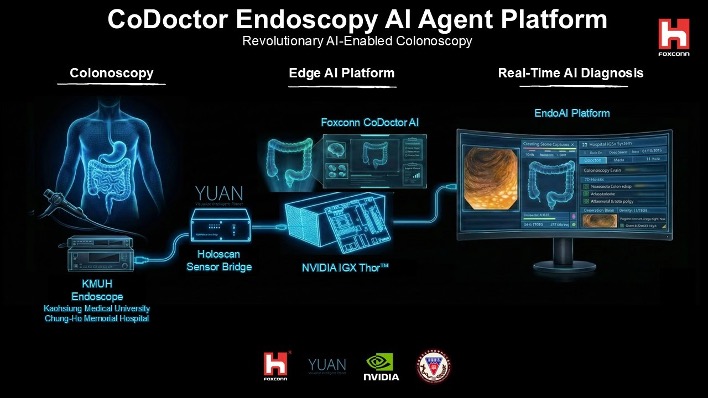
Integrating AI Agents, Robotics and Digital Twins to Accelerate the Rise of AI-Native Healthcare Infrastructure【Taipei, Taiwan — June 1, 2026】Foxconn (TWSE: 2317) today unveiled its latest Physical AI healthcare vision at COMPUTEX 2026 and NVIDIA GTC Taipei 2026, showcasing how AI agents, collaborative robotics, digital twins and multimodal medical AI are converging to transform real-world hospital operations and accelerate the emergence of next-generation smart hospitals. At a featured session held at the Taipei International Convention Center (TICC), Foxconn B Group President Barry Chiang joined Digital Health User Experience Design Director Alice Lin to present “Empowering Healthcare with Embodied Intelligence: From Nurabot Deployment to Smart Hospital Workflow Transformation.” The session highlighted how Foxconn is leveraging NVIDIA accelerated computing, simulation platforms and AI technologies to bring Physical AI from simulation into real-world clinical environments. As healthcare systems worldwide confront aging populations, workforce shortages and growing clinical complexity, Foxconn is advancing a next-generation healthcare AI ecosystem built upon AI infrastructure, multimodal medical models, embodied intelligence and clinical workflow orchestration. Rather than developing isolated AI tools, Foxconn is integrating AI systems capable of perceiving, reasoning and acting alongside healthcare professionals across hospital environments. Built upon NVIDIA’s “Five-Layer Cake” full-stack AI architecture spanning Energy, Infrastructure, Platform, Models and Applications, Foxconn showcased multiple healthcare innovations powered by technologies including NVIDIA Omniverse, NVIDIA Isaac, NVIDIA Holoscan, MONAI, NVIDIA Nemotron and NVIDIA NemoClaw. Together, these technologies enable the development of AI-native healthcare infrastructure designed to support increasingly autonomous, intelligent and real-world clinical operations.   Among the highlights was Nurabot, Foxconn’s nursing collaborative robot, which completed field validation last year and is now progressively expanding into hospitals and long-term care environments, including Taipei Veterans General Hospital, Tungs’ Taichung MetroHarbor Hospital, as well as overseas nursing education institutions. Real-world deployment data shows Nurabot can execute 75–80 tasks daily and help reduce nursing workload by approximately 30% through medication delivery, specimen transport and other clinical assistance workflows. Foxconn also showcased its scrub nurse collaborative robot, jointly developed with Kawasaki Heavy Industries, Taichung Veterans General Hospital and Yuan High-Tech. The system leverages the NVIDIA Isaac for Healthcare Agent-Ready Rheo Blueprint alongside NVIDIA Isaac GR00T Vision-Language-Action (VLA) architecture to enable multimodal perception, surgical scene understanding and intelligent task reasoning. Since its debut at GTC earlier this year, the project has achieved significant progress in simulation training and surgical workflow validation, with future clinical validation planned to accelerate the development of intelligent human-robot collaboration inside operating rooms. Another major showcase was Foxconn’s “Integrated Chemotherapy Drug Compounding and Delivery System for Smart Hospital Automation,” jointly developed with Taipei Veterans General Hospital, Kawasaki Heavy Industries, Yuyama Manufacturing and FARobot. Built upon real clinical workflows at Taipei Veterans General Hospital, the platform integrates chemotherapy drug compounding, autonomous intra-hospital transport and nursing delivery into a unified intelligent workflow. Powered by NVIDIA Omniverse, the system creates a virtual-physical integrated healthcare environment in which ChemoRo performs high-precision chemotherapy drug compounding, FARobot SMR30 autonomously transports medications within the hospital, and Nurabot supports last-mile delivery to nursing stations and patients. Together, the platform establishes a closed-loop workflow spanning compounding, transport and administration — helping improve operational efficiency, reduce manual workloads and enhance medication safety, traceability and process reliability in high-risk healthcare environments. Foxconn also introduced CoDoClaw, a clinical intelligent agent system built on NVIDIA NemoClaw, an open source blueprintfor deploying autonomous agents, like OpenClaw, with NVIDIA OpenShell for added privacy and security controls . Riding the rapid rise of agentic AI, CoDoClaw advances CoDoctor AI from standalone AI tools into a Multi-Agent Orchestration platform capable of coordinating AI agents across breast cancer screening, ECG analysis, fundus imaging and coronary artery analysis through a unified clinical interface. By connecting AI-driven lesion detection, appointment scheduling, report generation and follow-up management, CoDoClaw demonstrates how clinical AI agents can progressively support cross-department workflow orchestration and future healthcare automation. Foxconn envisions CoDoClaw as a foundational orchestration layer for future AI-native hospitals, enabling medical AI agents, robotics systems and clinical workflows to coordinate through shared operational intelligence. “Healthcare’s next transformation will not come from AI models alone, but from AI systems capable of perceiving, reasoning and acting in real-world clinical environments alongside healthcare professionals,” said Barry Chiang, President of Foxconn B Group and Digital Health. “Foxconn is building the next generation of intelligent healthcare through AI infrastructure, digital twins, embodied intelligence and ecosystem collaboration. We believe Physical AI will fundamentally reshape how hospitals operate and how care is delivered in the future.” Taiwan offers unique advantages for advancing smart healthcare and sovereign AI, combining world-class healthcare and national insurance systems, global leadership in semiconductors and AI infrastructure, and highly integrated clinical environments. Taiwan’s highly digitized healthcare ecosystem also provides an ideal real-world environment for validating Physical AI deployment and sovereign healthcare AI at scale. Through collaboration across government, hospitals and industry, Taiwan has the opportunity not only to address its own healthcare challenges, but also to help shape new operational models for intelligent healthcare worldwide. Moving forward, Foxconn will continue working with NVIDIA and ecosystem partners through the Taiwan Digital Health Alliance (HiMEDt) to accelerate Physical AI deployment across hospitals, long-term care and home healthcare environments, helping position Taiwan as a global showcase for next-generation smart healthcare transformation.
2026/06/01
Hon Hai Technology Group (Foxconn) Kathy Yang  Honored Among Fortune’s Most Powerful Women In Business 2026
2026/05/28
Hon Hai Technology Group (Foxconn) Kathy Yang Honored Among Fortune’s Most Powerful Women In Business 2026
28 May 2026, Taipei, Taiwan – Honoring women leaders who are shaping the global business landscape today, as well as those poised for even greater influence, Kathy Yang, Chief Campus Operation Officer and Head of AI Software Business, at Hon Hai Technology Group (Foxconn) (TWSE:2317) has been recognized in Fortune’s Most Powerful Women in Business 2026. Yang represents the only woman executive from Taiwan and ranks No 19 in the top 100. She is among 16 newcomers and one of 50 women at Fortune Global 500 companies in this year’s list, which features leaders from 20 countries and territories who serve 94 companies. “Maintaining a competitive edge is not only about leading in technology, but also about nurturing talent. This honor is an inspiration for all the women who work at Foxconn,” said Yang. “We are thrilled to spotlight women in leadership, which is an important marker in our journey toward becoming a comprehensive, world-class enterprise.” “In its 29th year, this iconic list of powerful women includes almost half from outside of the US, reminding us that the impact of women leadership is being seen globally,” said Alyson Shontell, Fortune Editor in Chief and Chief Content Officer. “These are women transforming business today and preparing for a future during a time of tumult and uncertainty, but also great promise.” Yang joins a distinguished group this year in which tech and finance dominate the list, with 27 and 26 women in each industry respectively. As AI continues its rapid rise, women are increasingly helping shape its future, according to Fortune. In nearly two decades at Foxconn, Yang – who last year was honored in Fortune’s MPW Asia list – has taken on progressively greater responsibilities at the world’s largest electronics manufacturer and leading technology solutions provider, from overseeing global logistics and trade compliance to being the first female executive to take a turn as Foxconn rotating CEO in 2025. The MPW 2026 list, compiled by Fortune editors, is based on the size and health of executives’ businesses or P&Ls, measured by 12-month and three-year financial data, as well as their influence, innovation, career trajectories, and efforts to make business better.
2026/05/28
Hon Hai Technology Group (Foxconn) Announces  First Quarter 2026 Financial Results
2026/05/14
Hon Hai Technology Group (Foxconn) Announces First Quarter 2026 Financial Results
• 1Q26 net profit up 19% on-year, operating profit surges 63% on-year• 1Q26 gross margin and operating profit margin both improve on-year• AI demand driving significant QoQ, strong YoY growth for 2Q26• FY 2026 outlook for strong growth unchanged14 May 2026, Taipei, Taiwan – Hon Hai Technology Group (Foxconn) (TWSE:2317) today announced its first quarter 2026 financial results:Revenue reached a record high of NT$2.12 trillion in the January-March period, while net profit attributable to the parent company totaled NT$49.9 billion, increasing NT$7.8 billion or 19% from the same period a year ago. Earnings per share in the first quarter hit NT$3.56. Looking ahead to the second quarter, although it is traditionally a slow season for the ICT industry, the Group expects to maintain an uptrend due to strong AI demand, with significant quarter-on-quarter growth and strong year-on-year growth. The full-year outlook remains unchanged, maintaining strong growth and providing greater visibility.In the first quarter of 2026, revenue reached NT$2.12 trillion, a year-on-year increase of 29%; gross profit was NT$131 billion, up 30%; operating profit was NT$75.6 billion, surging 63%; and net profit (attributable to the parent company's owners) was NT$49.9 billion, rising 19%. The gross profit margin, operating profit margin, and net profit margin were 6.18%, 3.57%, and 2.36%, respectively, compared with 6.11%, 2.83%, and 2.56% in the same period last year, showing an increase in both gross profit margin and operating profit margin. EPS reached NT$3.56, an increase of NT$0.53 compared with NT$3.03 in the same period last year.Faced with sustained, strong demand for the Group’s AI business, Foxconn Rotating CEO Michael Chiang said that with the ICT industry entering the traditional off-season in the first quarter, coupled with rapid growth in AI server demand, the Cloud and Networking product segment now accounts for nearly 50% of revenue. This demonstrates that the Group’s AI strategy has already brought about a structural transformation, helping to mitigate the seasonality of the ICT industry. At the same time, with a more diversified AI customer base, the Group’s product portfolio has become more balanced.Looking ahead to the Group’s second quarter performance, although the quarter is traditionally a slow season for the ICT industry, expectations are for maintaining an uptrend, with significant growth quarter-on-quarter and strong growth year-on-year, thanks to strong AI demand. The full-year outlook for strong growth remains unchanged. Visibility is higher.The Group's main product segments are Cloud and Networking, and Smart Consumer Electronics. In terms of the former, strong growth is expected both on a quarterly and yearly basis. In terms of the latter, with overall demand better than last year, significant growth is expected.During the investor call, the Group shared how it is building a moat through a sound financial constitution, while at the same time expanding investment and spending. Last year, capital expenditures increased about 27% on-year to NT$174 billion, and should rise more than 30% this year. The investments are primarily focused on regional manufacturing deployment, automation implementation, and upgrade of core capacity.Taking the first quarter as an example, the Group’s EBITDA rose to NT$102.4 billion. This indicates that as the Group actively invests in future growth, its overall financial health is staying robust. Capex is gradually translating into revenue and profit growth ahead.In addition, in terms of enhancing corporate value, the Group’s ROE for the first quarter reached 2.88%, representing a clear improvement compared to the same period over the past two years. This reflects ongoing progress in optimizing the Group’s profitability structure and operational efficiency. As AI-related business grows, as well as benefits materialize from a global footprint and vertical integration, there is further upside potential for ROE.Regarding recent market focus on co-packaged optics (CPO), rotating CEO Chiang said that CPO switches are scheduled to enter mass production in the third quarter, with annual shipments expected to reach tens of thousands of units. Based on current visibility, shipments are projected to grow multi-fold next year.CPO and 1.6T high-end switch products are currently being developed and prepared for mass production in cooperation with major cloud and AI data center customers, with shipments expected to begin in the third quarter. In addition to switch design and assembly, the Group continues to strengthen its capabilities in key components such as optical modules, optoelectronic integration, cables, connectors, high-speed transmission, and power management. By increasing the proportion of in-house production and integration, the Group aims to further enhance system performance, delivery efficiency, and supply chain control.For AI rack shipments, the Group expects to keep high double-digit growth in the second quarter. For the full year, AI rack shipments are projected to more than double, with quarterly volumes increasing sequentially as customer projects progress. In the area of high-speed switches above 800G, driven by growing demand for high-speed networking architectures in AI data centers, related product shipments and revenue this year also have the potential to double.In robotics, one of the key areas in the Group’s “3+3+3” strategy, humanoid robots and collaborative robots have already been introduced in US manufacturing sites in the second quarter. Operational data will be collected to support subsequent model optimization and large-scale deployment. In Smart City, the Group continues to deepen collaboration with local governments and partners, while promoting the export of integrated solutions, aiming to replicate successful experiences across more countries and cities.Lastly, in next-generation communications, the second-generation “PEARL” – Foxconn’s low Earth orbit (LEO) satellites – successfully launched on May 3 aboard a SpaceX Falcon 9 rocket, entering their designated orbit.While the first-generation satellites focused on satellite-to-ground communication experiments and system validation, the latest in orbit are equipped with Ka-band inter-satellite link (ISL) payloads. The two satellites will not only enable broadband communication between satellites and ground stations, but also validate inter-satellite communication between each other.Following the successful launch of the second-generation satellites, the Group will continue to accelerate its expansion in the space sector, focusing on diverse application scenarios such as mobile communication supplements, direct-to-device satellite connectivity, and connectivity in remote areas, further expanding opportunities in LEO satellite technology and smart communications integration.
2026/05/14
Quobly and Hon Hai Research Institute release an open-source toolbox to explore Quantum Phase Estimation for fault-tolerant quantum computing
2026/05/13
Quobly and Hon Hai Research Institute release an open-source toolbox to explore Quantum Phase Estimation for fault-tolerant quantum computing
Grenoble (France) and Taipei (Taiwan) – 12 May 2026 - Quobly, a French pioneer in silicon-based quantum computing, and Taiwan’s Hon Hai Research Institute, the R&D arm of Hon Hai Technology Group (Foxconn), today announced the release of an open-source numerical toolbox, jointly developed by the two partners, dedicated to the Quantum Phase Estimation (QPE) algorithm, a cornerstone of fault-tolerant quantum computing with major applications in quantum chemistry and materials science.QPE is widely regarded as a key algorithm for computing ground-state energies of molecular systems on future fault-tolerant quantum computers. While its theoretical properties and asymptotic cost scalings are well understood, practical resource estimates and realistic performance trade-offs remain largely unexplored, due to the difficulty of simulating QPE beyond toy models.The newly released toolbox aims to bridge this gap by providing researchers with a practical environment to explore QPE implementations and their resource implications, with a strong focus on understanding algorithmic building blocks and their practical implementation constraints.From theory to practice: exploring the full QPE pipelineThe QPE Toolbox is designed to give quantum algorithm practitioners a hands-on, numerical understanding of the full QPE workflow, from chemistry preprocessing to phase estimation, in a regime that challenges classical simulation while remaining computationally tractable.Built on advanced tensor network techniques, the toolbox enables users to:• Prepare physically motivated initial states using DMRG and matrix product states,• Encode molecular Hamiltonians into quantum circuits via trotterization or block-encoding / qubitization methods,• Compare textbook QPE with single-ancilla Robust Phase Estimation (RPE),• Analyze circuit depth, gate counts, and error sources without necessarily executing the circuit.The toolbox relies on the open-source quimb library and interfaces with standard quantum chemistry tools such as PySCF, ensuring compatibility with established workflows.The first release is designed as an educational and exploratory framework, enabling researchers to build intuition around the practical implementation of QPE and its variants.A modular tool for realistic numerical experimentsRather than attempting to simulate early fault-tolerant quantum computers,ith which are by nature beyond classical reach, the QPE Toolbox focuses on practical, interpretable numerical experiments in regimes accessible to classical computation, where algorithmic choices, initialization fidelity, and Hamiltonian encoding strategies can be explored in detail.Illustrative use cases enabled by the toolbox include (non-exhaustive):• Full circuit executions for ~10–20 qubits and circuits ranging from <1,000 to ~100,000 gates,• Ground state preparation for systems up to ~20–30 qubits,• Hamiltonian encoding for systems up to ~20–30 qubits,typically within a few hours or less on a standard laptop.These capabilities allow researchers to study trade-offs between precision, circuit depth, and resource requirements, and to build practical intuition about the behavior of QPE building blocks. The toolbox is therefore designed primarily as a pedagogical and exploratory platform, helping bridge the gap between theoretical proposals and their concrete implementation constraints.Open, collaborative, and evolvingThe QPE Toolbox is released as open source and is intended to evolve with the community. Future developments will include variational circuit synthesis, compressed fermionic encodings, and larger-scale tensor-network simulations.The toolbox is available on GitHub: https://github.com/quobly-sw/qpe-toolboxDocumentation and example workflows are provided to help researchers explore the different components of the QPE pipeline.“Our goal is to provide a practical, numerical playground for QPE, one that helps researchers move beyond purely theoretical cost models and develop realistic intuition for fault-tolerant quantum algorithms,” said Thibaud Louvet, Quantum Algorithms Scientist at Quobly.“By combining state-of-the-art quantum algorithms with advanced tensor-network techniques, this toolbox offers researchers a structured environment to explore and better understand the practical requirements of future quantum applications,” said Min-Hsiu Hsieh, Director of the Quantum Computing Research Center at Hon Hai Research Institute.The jointly developed software is free for use by academics and researchers. This collaboration reflects a shared commitment by Quobly and Hon Hai Research Institute to advancing algorithm-hardware co-design and accelerating progress toward practical fault-tolerant quantum computing. The end-to-end workflow of the Quantum Phase Estimation Toolbox (QPE Toolbox), jointly developed by Quobly and the Hon Hai Research Institute.About QuoblyQuobly is a pioneer in quantum microelectronics, developing silicon-based quantum chips using proven semiconductor manufacturing processes. Founded in 2022 in Grenoble, France, the company builds on over 15 years of collaborative research between world-class institutions CEA-Leti and CNRS, combining expertise in quantum physics and microelectronics. Co-founded by Maud Vinet, Ph.D. in quantum physics, author of 300+ papers and 70+ patents, and Tristan Meunier, a leading expert in semiconductor quantum engineering trained under Nobel laureate Serge Haroche, Quobly bridges science and industry to make quantum computing scalable and manufacturable.The company has a strategic partnership with STMicroelectronics to accelerate the industrialization of its silicon quantum chips. In 2023, Quobly raised €19 million, a record European seed round for a quantum hardware startup, followed in 2025 by €21 million to advance its Q100T program, a key step toward fault-tolerant quantum computing. Quobly has offices in France, Singapore, and Canada. Follow us on LinkedIn.Media contact to be adapted according to geographiesAbout Hon Hai Research InstituteThe institute, founded in 2020 and part of Hon Hai Technology Group (Foxconn), has five research centers. Each center has an average of 40 high technology R&D professionals, all of whom are focused on the research and development of new technologies, the strengthening of Foxconn’s technology and product innovation pipeline, efforts to support the Group’s transformation from "brawn" to "brains", and the enhancement of the competitiveness of Foxconn’s "3+3+3" strategy.
2026/05/13
Hon Hai Technology Group (Foxconn) and ElectroMobility Poland In Strategic Partnership To Develop Electric Vehicle Ecosystem
2026/05/07
Hon Hai Technology Group (Foxconn) and ElectroMobility Poland In Strategic Partnership To Develop Electric Vehicle Ecosystem
7 May 2026, Taipei, Taiwan – Hon Hai Technology Group (Foxconn) (TWSE:2317) plans to accelerate the development of clean mobility in the European region in strategic partnership with state-backed ElectroMobility Poland S.A. (EMP), the key driver of an ambitious initiative to raise the technological and operational capabilities of the electric vehicle ecosystem in Poland and the broader region. Together with Foxtron Vehicle Technologies, Foxconn and EMP are exploring the development for a production and research and development hub for electric vehicles in Poland. “Foxconn is deeply committed to accelerating electric mobility through open platforms, scalable manufacturing, and deep technological collaborations. We are excited to support EMP by sharing our EV platforms, vehicle development expertise and engineering capabilities to build an AI‑enabled manufacturing facility. Together, with Foxtron, we will foster local R&D and strengthen supplier networks to effectively serve the European market,” said Jun Seki, Foxconn Chief Strategy Officer for EV. “From the outset, we have designed this project around the need for a partner that combines industrial scale with technological depth. Foxconn meets these requirements – both in manufacturing and in the development and safety of digital solutions, which are now integral to the automotive sector and will remain a key source of competitive advantage,” said Cyprian Gronkiewicz, CEO of ElectroMobility Poland. The discussions, done with Poland’s Ministry of State Assets, and other institutions involved in the project, cover the scope of cooperation and is expected to lead to a detailed agreement package. Final agreement will be based on the results of negotiations and contract signing among the parties, subject to relevant regulatory requirements.   About ElectroMobility Poland S.A. ElectroMobility Poland is a state-owned company leading a key industrial project in Central and Eastern Europe focused on developing next-generation automotive manufacturing. The initiative aims to build an integrated hub combining production, R&D and competence development, enabling modern vehicle manufacturing and a strong local supply chain with European and global partners. Backed by the government, EMP offers stability, a long-term investment horizon and the ability to deliver large-scale strategic projects, supporting Poland’s transition to a modern, technology-driven economy. The company operates in a partnership model, creating opportunities for industrial, technology and financial partners to enter a growing market and co-create value within the evolving European automotive ecosystem. https://electromobilitypoland.pl/en/   About Foxconn Hon Hai Technology Group (Foxconn) (TWSE:2317) is the world’s largest electronics manufacturer and leading technology solutions provider, ranking 28th in Fortune Global 500. In 2025, revenue totaled TWD8.1 trillion (approx. USD260 billion). The Group’s market share in electronics manufacturing services (EMS) exceeds 40% and covers four major product segments: smart consumer electronics; cloud and networking; computing; and components and other. Operating over 240 campuses across 24 countries, Foxconn is one of the world’s largest employers with approx. 900,000 employees during peak manufacturing season. We are committed to sustainability in the manufacturing process and serving as a best-practice model for global enterprises.The Group is guided by its 3+3+3 strategy, actively investing in industries of electric vehicles, digital health, and robotics; in technologies of artificial intelligence, semiconductors and next-generation communications; in intelligent platforms of Smart Manufacturing, Smart EV and Smart City. Foxconn is dedicated to becoming a comprehensive, world-class enterprise, with AI as its core driving force.Learn more at www.foxconn.com/en-us
2026/05/07
Hon Hai Technology Group (Foxconn) Deepens Work In  LEO Satellite Communications With Second Mission Into Space
2026/05/04
Hon Hai Technology Group (Foxconn) Deepens Work In LEO Satellite Communications With Second Mission Into Space
3 May 2026, Taipei, Taiwan – Hon Hai Technology Group (Foxconn) (TWSE:2317) announced its second-generation low-Earth orbit satellites successfully launched Sunday from Vandenberg Space Force Base in California, marking a new phase in the field of LEO satellite communications by the world’s largest electronics manufacturer and leading technology solutions provider. The PEARL-1A and PEARL-1B, launched via the SpaceX Falcon 9 rocket as part of the CAS500-2 rideshare mission, both entered their intended orbits. The two second-generaton LEO satellites are primarily designed for payload technology verification in the fields of communication and space science. They are scheduled to conduct on-orbit missions for a duration of one to three years. While the first-generation PEARLs, which completed their two-year mission in January this year, focused on satellite-to-ground station communication and system validation, the second-generation satellites are further equipped with Ka-band Inter-Satellite Link (ISL) payloads. This technology enables not only broadband communication between satellites and ground stations, but also peer-to-peer transmission verification between the two satellites. Additionally, they carry a Compact Ionospheric Probe (CIP) to monitor the space communication environment. These advancements allow Foxconn to utilize beam planning and constellation design tools more effectively, strengthening its future application capabilities in LEO satellite systems. Hon Hai Research Institute, the R&D arm of Foxconn, was responsible for the pre-launch system integration of the latest LEOs, and will oversee the post-launch on-orbit operations and data verification. The PEARL project demonstrates Foxconn’s strategic positioning in the space industry. The project team has accumulated extensive experience from the orbital operations of the inaugural mission through receiving stations in Taiwan, Europe, and Svalbard, Norway. The Satellite Control Center, located at Foxconn’s headquarters in Taipei, conducted daily experiments seamlessly, gathering invaluable verification data. Currently, the PEARL LEO satellite design focuses on integrating Foxconn’s proprietary camera payloads with mature internal and external components. The core function of the satellite industry – Assembly, Integration, and Testing (AIT) – aligns with Foxconn’s innovative CDMS (Contract Design and Manufacturing Service) business model. By utilizing feedback from the first-generation satellites’ on-orbit operations, the R&D team can perform iterative system optimizations, creating a closed-loop development process. Moving forward, Foxconn will continue to pursue vertical integration to increase the self-production rate of components and enhance its global competitiveness. The core value of the PEARL mission series lies in establishing "on-orbit practical experience" to continuously optimize the design and integration capabilities of next-generation satellites. The Group will accelerate its focus on diverse application scenarios, including mobile communication supplements, Direct-to-Cell, remote area connectivity, Industrial Internet of Things (IIoT), and backup communications for specific environments. It remains committed to system integration, testing verification, and high-value-added services, building its space technology expertise to provide global satellite operators and partners with comprehensive technical support and contributing innovative energy to the global LEO satellite communication industry. About Foxconn Hon Hai Technology Group (Foxconn) (TWSE:2317) is the world’s largest electronics manufacturer and leading technology solutions provider, ranking 28th in Fortune Global 500. In 2025, revenue totaled TWD8.1 trillion (approx. USD260 billion). The Group’s market share in electronics manufacturing services (EMS) exceeds 40% and covers four major product segments: smart consumer electronics; cloud and networking; computing; and components and other. Operating over 240 campuses across 24 countries, Foxconn is one of the world’s largest employers with approx. 900,000 employees during peak manufacturing season. We are committed to sustainability in the manufacturing process and serving as a best-practice model for global enterprises. The Group is guided by its 3+3+3 strategy, actively investing in industries of electric vehicles, digital health, and robotics; in technologies of artificial intelligence, semiconductors and next-generation communications; in intelligent platforms of Smart Manufacturing, Smart EV and Smart City. Foxconn is dedicated to becoming a comprehensive, world-class enterprise, with AI as its core driving force. Learn more at www.foxconn.com/en-us
2026/05/04