We are based on the local area and look at the worldHomepage - English
Hon Hai Group
Homepage
America
Mexico
Europe
Czech Republic
Slovakia
Press Center
Latest News
Hon Hai Research Institute’s Two Quantum Works Accepted by FOCS 2026, World's Top Theoretical Computer Science Conference
2026/10/08
Hon Hai Research Institute’s Two Quantum Works Accepted by FOCS 2026, World's Top Theoretical Computer Science Conference
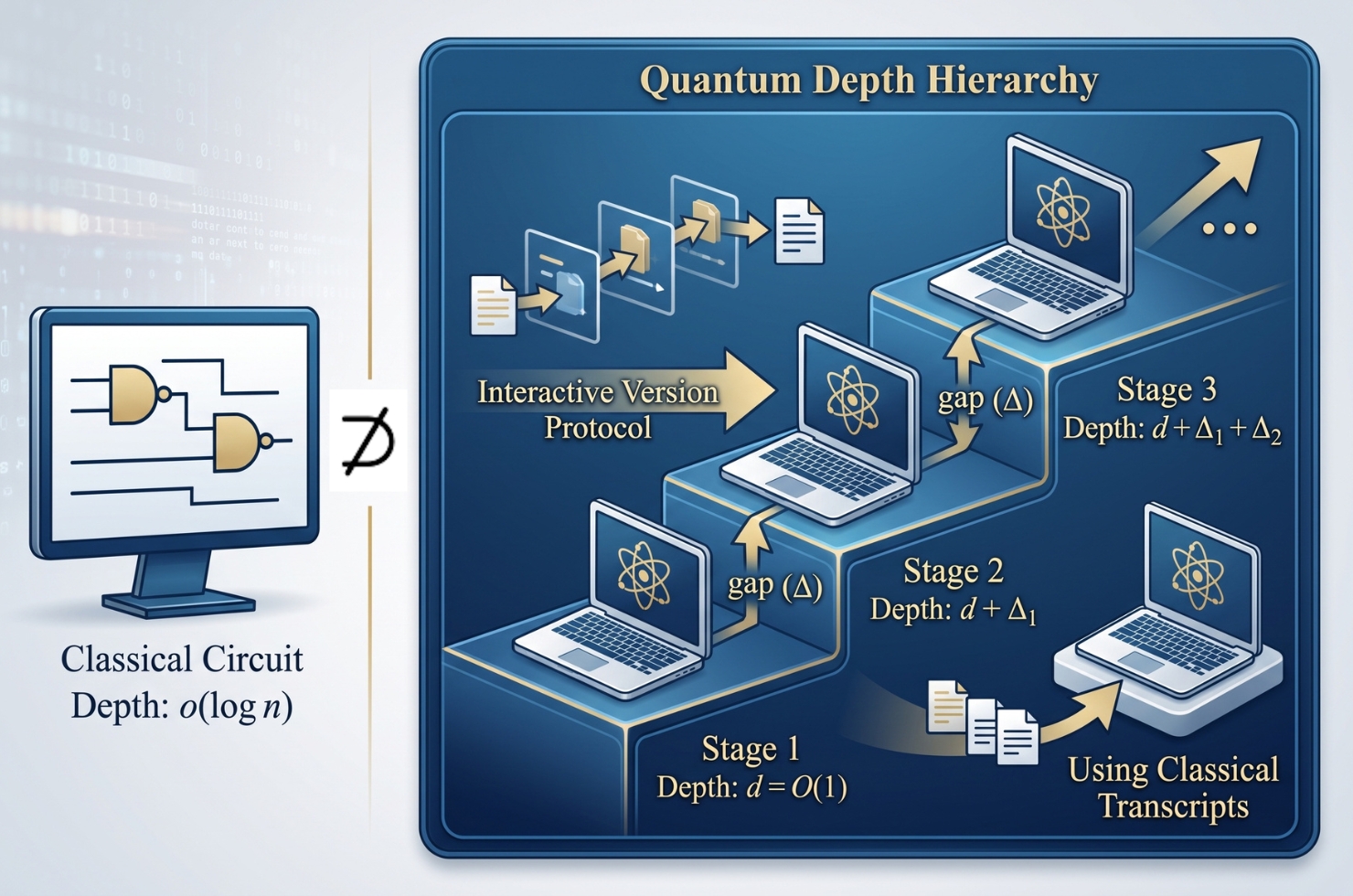
08 October 2026, Taipei, Taiwan – Demonstrating its strong forward-looking R&D capabilities, two fundamental theoretical studies from the Hon Hai Research Institute, under Hon Hai Technology Group (Foxconn), have been accepted by the IEEE Symposium on Foundations of Computer Science (FOCS 2026), universally recognized as the highest distinction in theoretical computer science. The 67th Annual FOCS 2026 will take place from November 8-11, 2026, in New York City, USA. As a flagship conference hosted by IEEE, FOCS stands alongside ACM's STOC as the premier academic venue in global theoretical computer science. The conference focuses on underlying mathematical theories such as algorithm design, computational complexity, cryptography, and quantum computing. The studies were conducted by Min-Hsiu Hsieh, Director of HHRI’s Quantum Computing Research Center, Researcher Michael de Oliveira, Intern Ding-Jun Lin, Intern Adam Wills, and an international collaborative team have both. The two accepted papers—"Worst-case depth hierarchy for shallow quantum circuits" (arXiv:2606.16425) and "Linear-Time Encodable and Decodable Quantum Error-Correcting Codes" (arXiv:2603.04543)—are not only the annual flagship achievements of the Hon Hai Research Institute’s Quantum Computing Research Center, but FOCS itself is a top-tier global theoretical computer science conference with an extremely high acceptance threshold. Notably, among all papers accepted by FOCS this year, Hon Hai Research Institute is the sole research entity representing Taiwan, fully highlighting Foxconn’s leadership in key foundational infrastructure for next-generation quantum technology. Mapping the Limits of Quantum Computational Power to Guide Algorithm Design The first accepted paper, "Worst-case depth hierarchy for shallow quantum circuits," focuses on the "depth hierarchy theory for shallow quantum circuits." In quantum computing, "circuit depth" resembles the total number of sequential steps that must be executed (equivalent to run time). Current quantum hardware, limited by technology, can only execute "shallow computations" with few steps and short run times. However, the scientific community has historically struggled to rigorously prove precisely how much of a leap in quantum computational capability occurs if the run time is increased by just a few additional steps. HHRI’s research team successfully established a mathematical framework that rigorously proves that for every additional layer of computational steps, the problem-solving domain of a quantum computer exhibits a distinct "hierarchical jump." This result is akin to mapping a precise "quantum computational capability chart," helping scientists worldwide clearly grasp the boundaries of current quantum devices, enabling the development of more efficient algorithms, and accelerating the realization of high-performance quantum computers. Equipping Qubits with "Ultra-Fast Protective Armor" to Build Ultra-Low Latency Error-Correction Technology The second paper, "Linear-Time Encodable and Decodable Quantum Error-Correcting Codes," tackles the most challenging noise issue in quantum computing—"linear-time encodable and decodable quantum error-correcting codes." While quantum computers possess immense processing power, qubits are extremely fragile. Minor temperature fluctuations or noise interference from the surrounding environment can instantaneously collapse the computational information. Therefore, quantum computers must detect and repair errors in real time within extremely short timeframes. However, if the computation for error correction and encoding is overly complex and time-consuming, qubits will degrade before the errors can even be fixed. The Quantum Computing Research Center team successfully developed an innovative encoding and decoding architecture that vastly simplifies the correction process, allowing computers to complete error-correction in highly efficient "linear time." This breakthrough is like equipping qubits with smart armor capable of "instant self-repair," laying a crucial cornerstone for building large-scale, stably operating quantum computers and quantum communication networks in the future. Cultivating Foundational Theory to Lead Next-Generation Technology Quantum technology is regarded as the core technology set to disrupt future cybersecurity, materials science, finance, and artificial intelligence. Yet, every hardware engineering breakthrough must be built on a foundation of underlying mathematics and algorithmic theory. HHRI director Hsieh stated that being the sole selection from Taiwan at this top-tier conference not only demonstrates that Taiwan's research in quantum foundational theory has reached world-class standards, but also confirms Foxconn’s commitment to cultivating advanced science and nurturing young scientific talent. Moving forward, the Quantum Computing Research Center will continue to collaborate with world-class research teams to provide the most solid theoretical support for next-generation technological infrastructure.
2026/10/08
Hon Hai Technology Group (Foxconn) Shares View  On AI Strength And “Made With Taiwan” At Semiconductor Tech Fests
2026/09/02
Hon Hai Technology Group (Foxconn) Shares View On AI Strength And “Made With Taiwan” At Semiconductor Tech Fests
Chairman & chip chief each sit for fireside chats at record SEMICON Taiwan 2 September 2026, Taipei, Taiwan – Hon Hai Technology Group (Foxconn) (TWSE:2317), the world’s largest electronics manufacturer and AI server provider, sees integration across the entire technology value chain to enhance ecosystem collaboration, flexibility and supply chain resilience as the way to stay ahead in next generation artificial intelligence infrastructure, with top executives stepping out this week to talk about what’s next in AI at major semiconductor conferences.  “Made With Taiwan” gives new meaning to an ecosystem collaborating with extreme efficiency because it can adapt fast amd move faster, and as systems are being optimized for intelligence, according to Foxconn executives driving upstream microelectronics development and world-beating AI infra build, at the annual SEMICON Taiwan on Wednesday and imec’s biennial ITF Taiwan on Monday. Young Liu, Foxconn Chairman, at Fireside Chat: Technology, Trust, and the Responsibilityof Innovation: “Because of AI, everything is speeding up. The whole world has to work collectively. We have to think differently. From now on, we have to think about how to ‘Made With Taiwan’, not ‘Made In Taiwan’”. Dr Bob Chen, President of Semiconductor Business Group at Foxconn, at Fireside Chat:From Silicon to Systems: Scaling AI infrastructure: “Organizations are no longer investing in infrastructure simply to run applications; they are building platforms to generate intelligence. The system itself becomes the new unit of innovation and competition. The industry is moving beyond optimizing individual components toward optimizing the entire stack.” The next major breakthroughs in AI will likely come from system architecture, that could bring compute, memory, connectivity, and power physically closer together through chiplets, 3D integration, silicon photonics, and memory-centric architecture, so that the AI system produces more intelligence per watt, said Chen in his conversation with imec CEO Patrick Vandenamelee. Semiconductor and system innovation are now tightly coupled with decisions made at the device, package, interconnect and system levels. Chen said this creates an important opportunity for collaboration between industrial system builders such as Foxconn and leading research hubs like imec. In a rare conversation among five Taiwanese tech titans on stage, Liu – who also heads TEEMA, which represents Taiwan’s technology supply chain of over 3,000 manufacturers of ICT products, semiconductors, automotive components and more – said the scale and speed of change in the AI industry is unprecedented. But Taiwan can adapt very quickly and move even faster, making it a best fit for customers and partner countries to share, collaborate and thrive together from the dividends of AI. With its partner programs and co-located events, SEMICON Taiwan is setting records this year. Foxconn’s support was visible with its active participation in collaborative tech fests, including Power and Compound Semiconductor Forum | NeXT Forum, co-hosted by the Hon Hai Research Institute; and the Quantum Taiwan Forum, opened by Dr Ching-Ray Chang, a Foxconn board director and a UNESCO Quantum 100 Honoree. The quantum industry is reaching a pivotal point. The landscape of quantum production and commercialization is moving from laboratories to fabs, from classrooms to cleanrooms, and from qubits to profits. The quantum forum was designed not only as an exchange platform, but to deeply integrate international innovations with Taiwan’s premier semiconductor and advanced packaging ecosystems, laying the hardware foundation for the next-generation quantum industry.   About Foxconn Hon Hai Technology Group (Foxconn) (TWSE:2317) is the world’s largest electronics manufacturer and leading technology solutions provider, ranking 23rd in Fortune Global 500. In 2025, revenue totaled TWD8.1 trillion (approx. USD260 billion). The Group’s market share in electronics manufacturing services (EMS) exceeds 40% and covers four major product segments: smart consumer electronics; cloud and networking; computing; and components and other. Operating over 240 campuses across 24 countries, Foxconn is one of the world’s largest employers with approx. 900,000 employees during peak manufacturing season. We are committed to sustainability in the manufacturing process and serving as a best-practice model for global enterprises. The Group is guided by its 3+3+3 strategy, actively investing in industries of electric vehicles, digital health, and robotics; in technologies of artificial intelligence, semiconductors and next-generation communications; in intelligent platforms of Smart Manufacturing, Smart EV and Smart City. Foxconn is dedicated to becoming a comprehensive, world-class enterprise, with AI as its core driving force. Learn more at www.foxconn.com/en-us
2026/09/02
Hon Hai Technology Group (Foxconn) Announces  Second Quarter 2026 Financial Results
2026/08/12
Hon Hai Technology Group (Foxconn) Announces Second Quarter 2026 Financial Results
·      2Q26 revenue, operating profit, net profit all at record highs for same period ·      3Q26 to see strong YoY growth, significant QoQ growth ·      Solid gains in 3Q26 for cloud and networking & smart consumer electronics ·      2027 demand for AI production capacity to stay very strong ·      Capex to grow in US, including Texas, Wisconsin, Ohio, California ·      Electromobility new business gaining ground in New Zealand, Poland, Saudi Arabia--12 August 2026, Taipei, Taiwan – Hon Hai Technology Group (Foxconn) (TWSE:2317) today announced its second quarter 2026 financial results. Revenue in the April-June quarter reached NT$2.53 trillion, that alongside operating profit and net profit, all set new second-quarter records. Net profit for the quarter was NT$60 billion, and earnings per share reached NT$4.27. Looking ahead to the third quarter, the traditional peak season, operations are expected to gradually pick up. Overall, the July-September quarter is expected to see significant quarter-on-quarter growth and strong year-on-year growth. For the full year 2026, thanks to strong demand for AI servers and growth in smart consumer electronics, the outlook for strong growth remains unchanged. In the second quarter, revenue reached NT$2.53 trillion, up 41% on year; at the same time, gross profit was NT$154.5 billion, rising 36%; operating profit at NT$94.8 billion, increased 68%; and net profit (attributable to the parent company's owners) was NT$60 billion, gaining 35% on year. Gross profit margin, operating profit margin, and net profit margin were 6.12%, 3.75%, and 2.37%, respectively. EPS reached NT$4.27, an increase of NT$1.08 compared to NT$3.19 in the same period last year. Revenue, operating profit, and net profit all reached record highs for the same quarterly period. In the first half of 2026, revenue reached NT$4.65 trillion, increasing 35% from a year ago; at the same time, gross profit was NT$285.5 billion, up 33%; operating profit was NT$170.5 billion, jumping 65%; and net profit was NT$109.9 billion, rising 27%. Gross profit margin, operating profit margin, and net profit margin were 6.15%, 3.67%, and 2.37%, respectively. EPS reached NT$7.84, an increase of NT$1.61 compared to NT$6.23 in the same period last year. Revenue, operating profit, and net profit all reached record highs for the first half of the year. Amid significant market interest regarding the mass production progress of AI and smart consumer electronics products for key clients, Foxconn Rotating CEO Michael Chiang stated the Group is seeing sustained volume growth in AI server racks driven by continued capital expenditure expansion among cloud service providers (CSP). Cloud and networking products are projected for strong growth in the third quarter, with high double-digit increases both on-quarter and on-year. For the same period, revenue for smart consumer electronics, given traditional peak season in the second half of the year, is expected to show significant growth sequentially in the July-September quarter and compared to a year ago. As Foxconn continues to expand its market share in AI server racks, Chiang said Foxconn's advantage in AI lies in providing complete, end-to-end system solutions, rather than just single products. With Vera Rubin (VR) racks entering mass production in the third quarter, overall AI server rack revenue is expected to increase quarter-on-quarter, and shipments are projected to achieve high double-digit growth. For the full year this year, AI rack shipments are also expected to more than double. Shipments of high-performance networking products are moving ahead and full-year revenue from 800G and higher switches is expected to double, while co-packaged optics (CPO) all-optical switches are on track for mass production and shipment in the third quarter. Foxconn’s sustained strength in operational performance comes down to its global footprint and economies of scale, said Chiang. With more than 240 sites in 24 countries, and longstanding, deep development of vertically integrated and highly automated operations, alongside a high in-house production ratio of key components, the Group is able to maintain sound operating efficiency and yields in the face of high unit price and highly complex AI products. Taking an example, he said, currently the Group’s automation rates of processes in computer numerical control (CNC) and surface mount technology (SMT) are close to 100%. Ultimately, it is the collaboration with top-tier customers to develop products, focusing on forward-looking and proprietary technologies, increasing the proportion of high-value-added products, that drives Foxconn's transformation into a technology manufacturing platform service provider. On the subject of the Group’s cash flow supporting its huge operations and mass production work, Chiang said AI has brought significant benefits to Foxconn's financial performance. Investment expansion and order intake in the first half of this year has led to capital expenditure growing 5% on year to NT$80.9 billion, and net interest expense increasing by NT$6.6 billion annually. However, he pointed out that well-outpacing the spending and interest expense was a bigger 52% year-on-year jump in adjusted EBITDA in the first half, making clear a healthier cash flow. In the January-June period this year, adjusted EBITDA reached NT$227.7 billion, up by NT$77.6 billion. Regarding the ROE and operating profit margin indicators, Chiang stated the ROE for the first half of this year reached 6.21%, an increase of 0.73 percentage point compared to the same period last year, reaching half of the Group's 12% target, with further room for improvement. Operating profit margin – at 3.67% in the January-June period, improving 0.67 percentage point year-on-year – not only met the Group's 3% target, but should also exceed last year's full-year level of 3.2%. Looking ahead to next year, Chiang said customer demand for AI production capacity will still be very strong. Foxconn’s capex will continue to increase in locations including Taiwan, the United States, Mexico and Vietnam; among sites, in response to American localization needs, Texas, Wisconsin, Ohio and California will see build up in R&D and manufacturing capabilities. The Group currently has no plans for direct equity financing and will maintain a sound capital structure to meet future operational and expansion needs. Among positive developments in new business areas, Japan’s Mitsubishi Motors in New Zealand recently officially confirmed EV models under partnership, with Chiang noting vehicle deliveries starting in the second half of this year. In Europe, work with state-backed ElectroMobility Poland (EMP) is continuing to advance, while in MENA, production is expected to officially start in the fourth quarter for the joint venture in EV charging infrastructure in Saudi Arabia. Meanwhile, at home, delivery began in July for new car model CAVIRA based on the MODEL C, and the new Kaohsiung factory also started mass production of MODEL T and electric bus batteries. In a call out for October, Hon Hai Tech Day 2026 this year will be held October 30-31. In its 7th year, Foxconn’s flagship show will take place at an unprecedented scale, combining the first and fourth floors of Taipei Nangang Exhibition Center, Hall 1, to demonstrate the Group’s latest technological achievements from its three major smart platforms and deep integration of AI. New product reveals are planned. The two-day annual conference will launch for the first time a family-friendly pavilion for children to explore cool zones and dream jobs related to technology. Free entry on the second day, hands-on exploratory themes for the young include sustainability, mobility, smart factory and smart city. Foxconn sincerely invites one and all to come!     About Foxconn Hon Hai Technology Group (Foxconn) (TWSE:2317) is the world’s largest electronics manufacturer and leading technology solutions provider, ranking 23rd in Fortune Global 500. In 2025, revenue totaled TWD8.1 trillion (approx. USD260 billion). The Group’s market share in electronics manufacturing services (EMS) exceeds 40% and covers four major product segments: smart consumer electronics; cloud and networking; computing; and components and other. Operating over 240 campuses across 24 countries, Foxconn is one of the world’s largest employers with approx. 900,000 employees during peak manufacturing season. We are committed to sustainability in the manufacturing process and serving as a best-practice model for global enterprises. The Group is guided by its 3+3+3 strategy, actively investing in industries of electric vehicles, digital health, and robotics; in technologies of artificial intelligence, semiconductors and next-generation communications; in intelligent platforms of Smart Manufacturing, Smart EV and Smart City. Foxconn is dedicated to becoming a comprehensive, world-class enterprise, with AI as its core driving force. Learn more at www.foxconn.com/en-us
2026/08/12
Visionbay.ai Launches Taiwan's Largest 5MW NVIDIA HGX B300 AI Cluster and Achieves NVIDIA Exemplar Cloud Validation
2026/07/31
Visionbay.ai Launches Taiwan's Largest 5MW NVIDIA HGX B300 AI Cluster and Achieves NVIDIA Exemplar Cloud Validation
Delivers Production-Grade AI Infra to Accelerate Enterprise AI Adoption Through a Tokenized AI Factory【31 July 2026, Taipei, Taiwan】Visionbay.ai (“Visionbay”), an NVIDIA Cloud Partner (NCP) in Taiwan, today announced the commercial launch of its first 5MW AI cluster powered by NVIDIA HGX B300 systems, the largest deployment of its kind nationwide. Featuring direct liquid cooling, a 2N high-availability architecture, and connected with NVIDIA Quantum-X800 InfiniBand networking, the cluster is purpose-built for large-scale AI training and inference. It has already signed its first long-term enterprise customers and has entered commercial operation with utilization exceeding 90%. Together, these milestones position Visionbay as one of the leading AI infrastructure providers in the Asia-Pacific region. The cluster has also achieved NVIDIA Exemplar Cloud validation for training workloads on NVIDIA HGX B300, making Visionbay one of the first ten organizations globally — and the second in Asia — to achieve NVIDIA Exemplar Cloud validation as an NVIDIA Cloud Partner. The achievement underscores Visionbay's ability to deliver world-class AI infrastructure and software operations at enterprise scale.   As generative AI, agentic AI, and multimodal foundation models advance, enterprises need more than access to GPUs — they need infrastructure that can reliably support production environments. NVIDIA Exemplar Cloud is a validation initiative  to optimize infrastructure for predictable, production-scale AI performance. Using the NVIDIA Performance Benchmarking and real-world LLM workloads, including DeepSeek-V3, Llama 3.1, Qwen3, and Grok-1, the validation verifies compute performance, network efficiency, cluster stability, and long-duration operational consistency. For enterprise customers, it provides independent assurance that a platform is ready for production deployment — reducing risk and accelerating AI adoption at scale. The achievement also reinforces Visionbay's vision of building a Tokenized AI Factory. Unlike conventional GPU cloud platforms, Visionbay unifies AI infrastructure, GPU cloud services, an AI operations platform, and Token Factory capabilities into a single platform supporting the entire AI lifecycle — from model training and fine-tuning to inference and AI agent deployment. Operating its data center to Tier III-class standards with enterprise-grade security, Visionbay delivers Day-1 operational readiness, ensuring large-scale GPU clusters can be continuously managed, optimized, and delivered as an enterprise service. This helps enterprises accelerate AI commercialization while lowering operational complexity and deployment risk. Looking ahead, Visionbay will continue expanding its AI infrastructure across the Asia-Pacific region powered by NVIDIA Blackwell and NVIDIA Vera Rubin architectures. Leveraging Foxconn's vertically integrated strengths in critical components, AI infrastructure, and AI software platforms, Visionbay is building an end-to-end Tokenized AI Factory that empowers enterprises, governments, and ecosystem partners to scale AI innovation and help shape the next wave of the AI economy. AboutVisionbay.ai Visionbay.ai is the Hon Hai Technology Group’s dedicated business unit for supercomputing and cloud-AI operations. With a mission to empower Asia’s AI ecosystem, Visionbay.ai integrates national-level computing infrastructure with Hon Hai’s deep strengths in manufacturing, design, and supply-chain orchestration. Its end-to-end AI Factory solutions span high-performance compute, cloud operations, supply-chain integration, AI model and tool development, and an AI App Store. Visionbay.ai helps enterprises accelerate digital and AI transformation while building a trusted and sustainable sovereign-AI ecosystem. To learn more, visit  www.visionbay.ai
2026/07/31
IBM and Visionbay.ai to Accelerate the Next Era of AI across Asia Pacific
2026/07/23
IBM and Visionbay.ai to Accelerate the Next Era of AI across Asia Pacific
Visionbay.ai and IBM collaborate to deliver a trusted, scalable, full-stack AI platform across the region Singapore, July 21, 2026 – Today IBM (NYSE: IBM) and Visionbay.ai (“Visionbay”) – backed by Hon Hai Technology Group (Foxconn) — announced a collaboration to develop an AI platform and expand Visionbay’s AI App Store for enterprises and regulated industries across Asia Pacific.Built on Visionbay’s AI infrastructure and cloud operations, Red Hat OpenShift will provide the hybrid cloud foundation for managing AI workloads and IBM’s watsonx AI portfolio will support AI development and governance capabilities. Together, the companies will provide an integrated AI platform that supports the full AI lifecycle — including model development, fine-tuning, deployment and AI services. By delivering a repeatable, full-stack architecture for enterprise deployment, the platform can help organizations move AI workloads from experimentation into production with greater speed, efficiency, and consistency with built-in enterprise governance.These complementary capabilities can be accessed through Visionbay’s AI App Store, which will offer ready-to-use AI agents and AI applications tailored for businesses, enabling organizations to discover, deploy and govern AI securely while maintaining three critical layers:*Data Residency – keeping data, models and intellectual property within defined jurisdictions and customer-controlled environments.*Operational Control – enabling localized operation, management and optimization of critical AI infrastructure.*Governance and Compliance – adhere to regulatory requirements, security standards and auditability required by governments and regulated industries.Through a Build-Operate-Localize model, IBM and Visionbay will help governments and regulated industries establish the operational foundation needed to scale AI services securely and reliably across environments — enabling local ownership of critical infrastructure, accelerating enterprise adoption, developing AI talent, and creating economic opportunities.The collaboration marks an important milestone in Visionbay's strategy to expand beyond AI infrastructure by growing its AI App Store and software ecosystem, enabling customers to access enterprise AI solutions through a unified commercial platform. It will begin with deployments in Taiwan and expand across Asia Pacific, supporting industries including governments, financial services institutions, telecommunications providers and other regulated sectors.“IBM and Visionbay.ai will help nations establish AI as a new digital industry — enabling local ownership of critical infrastructure, accelerating enterprise adoption, developing AI talent, and creating economic opportunities across the ecosystem. Our Build-Operate-Localize model represents the next evolution of AI infrastructure. Together with IBM, we are creating the foundation for trusted AI adoption across Asia,” said Neo Yao, CEO, Visionbay.ai.“The AI era is driving the need for a new kind of enterprise infrastructure, and this collaboration will help enterprises and regulated industries unlock their full potential with open, flexible, and secure AI solutions to thrive in a rapidly changing world,” said Hans Dekkers, GM, IBM Asia Pacific. “Through combining Visionbay’s AI infrastructure with IBM’s enterprise AI, hybrid cloud and technology expertise, we are helping clients across Asia Pacific accelerate AI transformation with security, control and consistency.”This collaboration also strengthens Visionbay's software ecosystem, enabling customers to access trusted enterprise AI applications alongside AI infrastructure through a single platform. The integrated platform supports flexible consumption models across the AI value chain — from GPU-as-a-Service (GPUaaS) providing access to accelerated computing resources, AI Platform-as-a-Service (AI PaaS) enabling model development, deployment and governance, to AI-as-a-Service (AIaaS) delivering industry-specific AI solutions for intelligent customer engagement, risk management, operational automation and productivity transformation.
2026/07/23
Hon Hai Technology Group (Foxconn) Improves In Independent Audits At Global Sites For 3rd Year
2026/07/08
Hon Hai Technology Group (Foxconn) Improves In Independent Audits At Global Sites For 3rd Year
Top-marked Brazil and China’s Yantai sites certified highly in RBA VAP assessment08 July 2026, Taipei, Taiwan – Deepening the core philosophy of “EPS+ESG=Sustainability” at the world’s largest electronics manufacturer, Hon Hai Technology Group (Foxconn) (TWSE:2317) completed independent, third-party audits covering major manufacturing sites including Brazil, Vietnam, China, India and Mexico, reflecting a commitment in governance to drive operational discipline, risk visibility, and continuous improvement across its global footprint. No priority non-conformances as defined by the Responsible Business Alliance (RBA) Validated Assessment Program (VAP) were found. Covering areas of labor rights, occupational health and safety, environmental protection, business ethics and supply chain management, the latest audit returned an overall compliance rate of 89.7%, reflecting solid improvement in the Group’s global audit work for the third year in a row. As of the end of 2025, the Group has completed 85 RBA VAP audits across 65 sites worldwide, earning a total of six Platinum, two Gold, and 33 Silver certifications.In 2025, enhanced RBA VAP audits were also conducted at nine major sites, which were selected based on risk factors including operational complexity, workforce size, geographic risk, and historical stakeholder concerns, with the aim of strengthening ESG governance in higher-risk locations. In its inaugural RBA VAP audit, Foxconn’s Sao Paulo site in Brazil attained top marks, scoring a full 200 and receiving a Platinum certification. Foxconn China’s Yantai site, also undergoing its first RBA VAP audit, earned a Silver certification. Other sites in China, alongside those in India and Mexico, underwent consecutive audits showing continued improvement compared with previous assessments. The nine enhanced audited sites accounted for 121 auditor-days, with 1,279 employees interviewed. The audit scope covered all aspects of the RBA Code of Conduct, including labor, health and safety, environmental protection, business ethics, management systems, and supply chain responsibility. Other key findings included: Sites in China (Chengdu, Zhengzhou, and Yantai) and Mexico (Chihuahua) obtained Silver certification. Environmental conformance reached 93.5%, and business ethics conformance reached 96.5%, maintaining strong performance. Sites undergoing consecutive audits for two years showed, on average, a solid 19.1% improvement gain in points; the Chengdu site improved by 46.2 points, with progress across labor, health and safety, and environmental dimensions. Mexico’s Chihuahua site achieved a 133% improvement in supply chain management compliance, reflecting continued enhancement in supply chain maturity The report also highlighted labor rights, occupational health and safety, and supply chain management as key areas for further improvement. It recommended continued efforts to reduce disparities in ESG management and execution maturity across sites. Looking ahead, Foxconn will continue to enhance global consistency and ESG governance maturity through third-party audits, management system optimization, capability building, and cross-site best practice sharing. Read report here
2026/07/08